Most Popular Smart Speaker in the US 2026?
Looking to find out which smart speaker reigns supreme in American homes? The answer, as of early 2026, is still the Amazon Echo. This popular device commands a significant lead, capturing between 65% and 67% of the total smart speaker market share across the United States. That translates to a staggering 101 million users over the age of 12 enjoying the convenience of Alexa in their daily lives. Even with increasing competition, about 35% of American households have consistently embraced smart speakers since 2022, proving its enduring popularity.
So, how did Amazon secure such a commanding position? The company’s success is largely due to its pioneering presence in the market. Coupled with attractive pricing – think of the accessible Echo Dot at just $49.99 – and the seamless integration of Alexa across more than 100 million connected devices, Amazon has built a considerable advantage. This widespread adoption keeps Amazon comfortably ahead of its rivals, Google Nest (holding roughly 17% to 27% of the market) and Apple HomePod (claiming 15% to 21%). Consistently, surveys reveal that Alexa-powered speakers boast higher rates of both single and multiple device ownership.
The smart speaker arena is constantly evolving, with new features and innovations emerging from all the major players. As smart home adoption continues its upward trajectory, now present in over 103 million households across the US, the market for these voice-activated assistants expands right along with it. But despite the growing competition, studies consistently show that Americans trust and prefer Amazon’s Echo above all others, solidifying its place as the most ubiquitous smart speaker in the nation.
Key Takeaways
- Approximately 35% of Americans aged 12 and older currently own at least one smart speaker – that’s about 101 million people enjoying the convenience of voice control.
- When it comes to brand loyalty, Amazon Echo consistently leads the pack as the most popular smart speaker in the U.S., claiming between 65% and 67% of the market.
- The Google ecosystem represents the next largest player. Google Home is reported at around 24% and Google Nest at 17% for brand ownership, with some summaries showing Google Home nearing 27%.
- Apple HomePod’s ownership typically falls in the high teens to low 20% range, reported anywhere from 18% to 21%, depending on the specific survey and measurement methods used.
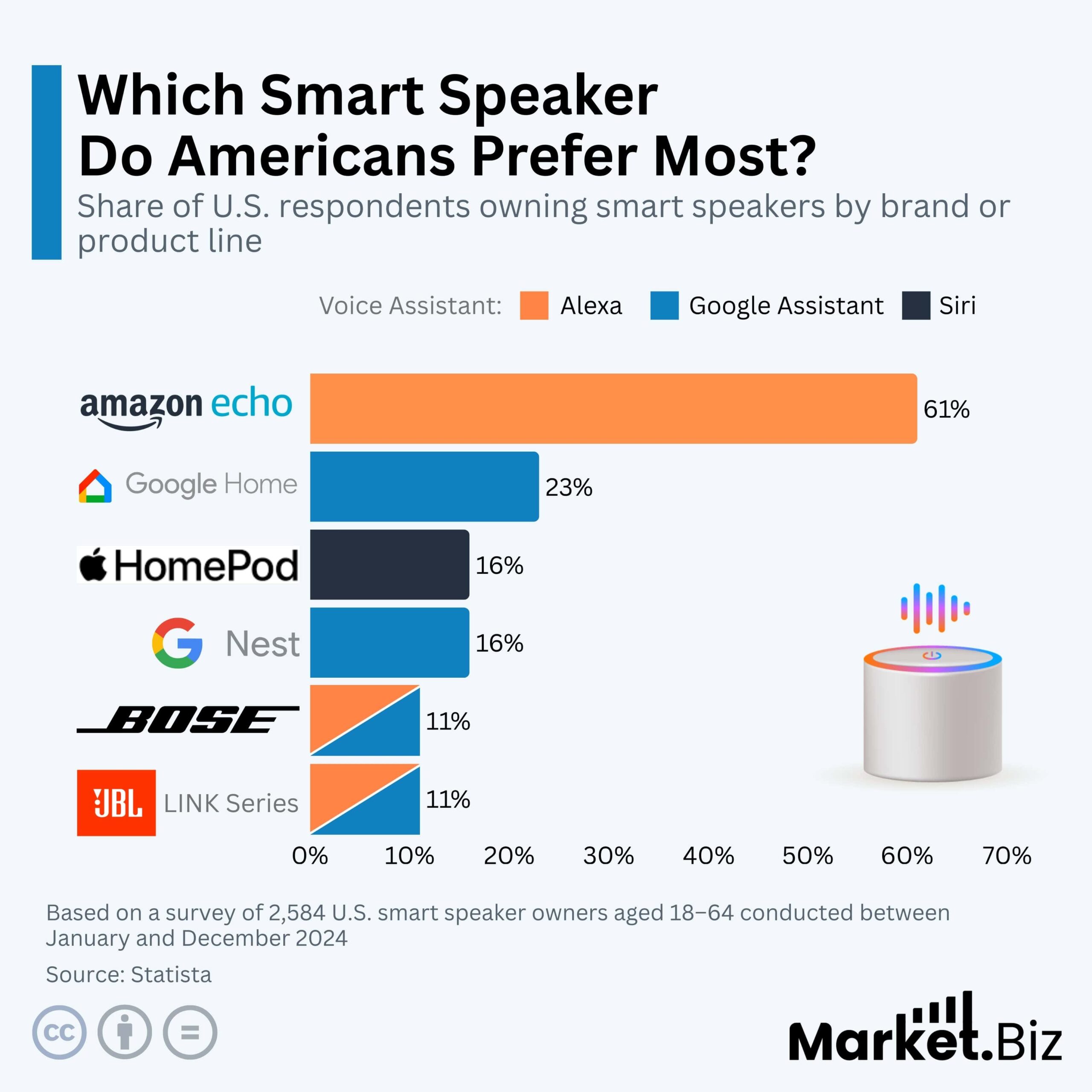
- Across U.S. adults, a commonly cited ownership breakdown reveals that around 23% own an Amazon Alexa device, about 11% own a Google Nest device, and approximately 2% own an Apple HomePod. It’s important to remember that some users own devices from multiple brands.
- According to a widely referenced smart audio study, smart speaker adoption peaks among those aged 45–54 at 24%, and remains strong at around 22% for those 55 and older.
- Estimates for the number of Alexa users in the U.S. vary depending on the source, but one popular forecast anticipated around 75.6 million U.S. Alexa users by 2024.
- In 2024, the U.S. smart speaker market was estimated at $5.987 billion. Projections indicate significant growth, reaching $28.19 billion by 2033, reflecting a compound annual growth rate (CAGR) of 20.77% over that period.
- Looking ahead, one forecast projects that the number of smart home users in the United States could reach 103.15 million by 2028, a substantial 65% increase over the year previously referenced in the report.
- Globally, smart speaker shipments are anticipated to reach approximately 156 million units in 2025, representing about a 4% year-over-year increase.
- A large part of smart speaker use revolves around audio, with 58% of owners using their devices to listen to music and another 66% relying on them to stay informed with the news.
- As of now, you can typically find the Echo Dot (5th Gen) priced around $49.99 and the Echo Studio around $199.99, though prices are always subject to change based on retailer and promotional offers.

Source: Market.Biz (Which Smart Speaker Do Americans Prefer Most?)
Current Market Dominance
Recent studies confirm that the Amazon Echo continues to be the go-to smart speaker for most Americans. Data gathered between 2024 and 2026 suggests that roughly 65% of U.S. households boast an Echo device, which works out to about 67 million active devices humming away. This robust figure points to Amazon’s expanding influence in the smart home, especially when compared to earlier years (between 2019 and 2021), where its market share lingered around 70%.
A major ingredient in Amazon’s ongoing triumph is its diverse product lineup that caters to various budgets and needs. You can snag an Echo Dot for just $49.99 or splurge on the higher-end Echo Studio for $199.99. What’s more, the Alexa ecosystem is thriving, boasting a strong community of 71.4 million users and supporting a staggering 100 million connected devices as of March 2024.
While still significant, Google Nest smart speakers hold a smaller slice of the market, capturing between 17% and 27% of US households (broken down as 24% for Google Home and 17% for Nest). Users are often drawn to the advanced natural language processing of Google Assistant. Then there’s Apple’s HomePod, claiming a 15-21% share, predominantly among iOS devotees. The HomePod earns praise for its exceptional audio quality, particularly the spatial sound capabilities in the second-generation model, available for $299.
Smart speaker adoption in the U.S. reached 35% of the population aged 12 and older in 2025, equaling 101 million users. Remarkably, this adoption rate has remained consistent since 2022, even as the number of smart homes continues to surge past 103 million. Recent improvements to these devices include Amazon’s Echo Pop ($60, powered by the speedier AZ2 processor), Apple’s second-generation HomePod Mini (now equipped with temperature and humidity sensors), and Google’s refinements to Nest Audio, offering enhanced AI-driven sound.
Expert reviews from trusted sources such as RTings and CNET consistently place the Echo Studio as the top overall smart speaker. The JBL Authentics 500 stands out for its support of both Alexa and Google Assistant, while the Sonos Era models are frequently lauded for their high-fidelity audio. All things considered, however, the Amazon Echo remains the favorite for the majority of consumers.
Owning multiple devices is becoming more common, with 41% of users reporting they have two or more smart speakers at home. Daily usage remains high, especially when it comes to music. Around 58% of owners (roughly 72 million households) use their speakers every day. North America represents 41.3% of the global smart speaker market, with the United States taking the lead, propelled by a wide selection of Alexa-compatible devices and significant growth in voice-activated shopping, which expands at a rate of 22.7% annually.
Competitive Comparison
| Feature/Metric | Amazon Echo | Google Nest | Apple HomePod |
| Context Window | 1M tokens (Alexa LLM) | 1M tokens (Gemini) | 200K tokens (Siri) |
| Pricing per 1M Tokens | $0.0025 input/$0.003 output | $0.0001 input/$0.0005 output | N/A (ecosystem-locked) |
| Multimodal Support | Voice + limited vision (Echo Show) | Voice + video (Nest Hub) | Voice + spatial audio |
| Agentic Capabilities | Routines, skills, smart home hub | Adaptive routines, Matter | HomeKit automation |
Amazon Echo’s strength lies in its widespread market penetration and affordability for frequent users. In contrast, Google Nest stands out for its cost-effectiveness and its seamless integration with various multimedia functions. The HomePod offers a premium audio experience but lags in terms of overall system openness and flexibility.
Reasons Behind Amazon’s Market Leadership
Amazon’s continued dominance in the U.S. smart speaker landscape can be attributed to a significant first-mover advantage. The Echo was initially introduced back in 2014, giving Amazon a head start in establishing itself in the market.
Want to know which smart speaker dominates American homes? The answer is clear: Amazon’s Echo. Let’s dive into why Amazon holds such a significant lead in the US smart speaker market and what the future might hold.
Amazon’s Domination
Amazon’s Echo has surged to the front of the pack by capitalizing on a smart strategy: offering affordable options. Their aggressive pricing enabled them to rapidly capture over 70% of the market share. Crucially, nearly half (48%) of smart speaker owners choose the budget-friendly Echo Dot. With Alexa, Amazon’s popular voice assistant, now integrated into over 100 million devices, Amazon has solidified its presence in homes across the country.
The key to Amazon’s success lies in its ecosystem, which fosters strong user loyalty. Currently, a substantial 23% of US adults own an Echo device, dwarfing Google Nest (11%) and Apple HomePod (2%). One of the biggest draws is seamless integration with other smart home devices, cited as important by 27% of buyers. Alexa’s broader compatibility with more brands and products gives it a significant advantage over its rivals.
Amazon’s leadership extends to key performance indicators: a whopping 65% of US smart speaker owners use Echo devices, representing 71.4 million Alexa users. While Google once reached a peak market share of 31% in shipments, that number has been declining since 2021.
Amazon continues to retain users by offering robust privacy features, support for multiple languages, and an impressive library of over 60,000 Alexa “skills.” This multifaceted approach drives high engagement, with 52% of Echo owners using their devices daily. The result? Listening time has exploded, increasing by a remarkable 400% in recent years.
Future Outlook
Looking ahead, all signs point to Amazon maintaining its dominance in the US smart speaker market through 2030. Projections estimate the market will reach a staggering $28 billion by 2033, growing at an annual rate of 20.77%. However, Google is poised to become a fiercer competitor by enhancing its artificial intelligence with Gemini AI and offering more affordable devices. New standards like Matter, designed to unify smart home systems, could further boost Google’s market share, potentially reaching 30%.
Apple’s HomePod also has the potential for growth, possibly capturing a 25% market share if Apple’s new multimodal intelligence features resonate with consumers. However, Apple’s tightly controlled ecosystem may limit its expansion. Overall, as the market becomes saturated, the percentage of Americans owning smart speakers may slightly decrease to 30.8%. The focus will shift towards upgrading existing devices with advanced features, such as AI agents boasting 95% accuracy.
By 2025, global shipments of smart speakers are expected to reach an impressive 156 million units. Voice-based shopping is likely to continue its upward trajectory, growing at an annual rate of 22.7%. As consumer preferences evolve, enhanced privacy features will become increasingly crucial. Amazon is well-positioned to maintain its lead as long as Alexa continues to evolve with innovative features. However, Google and Apple could gain significant ground by prioritizing superior audio quality and cutting-edge technology.
Conclusion
In conclusion, Amazon’s Echo currently reigns supreme in the US with over 65% market share. However, the intensifying competition, especially from Google Nest with its advanced AI and multimodal capabilities, suggests that Amazon’s lead could erode by 2027. For investors and market watchers, keeping a close eye on Matter adoption and pricing strategies will be essential for understanding the future landscape of the smart speaker market.