
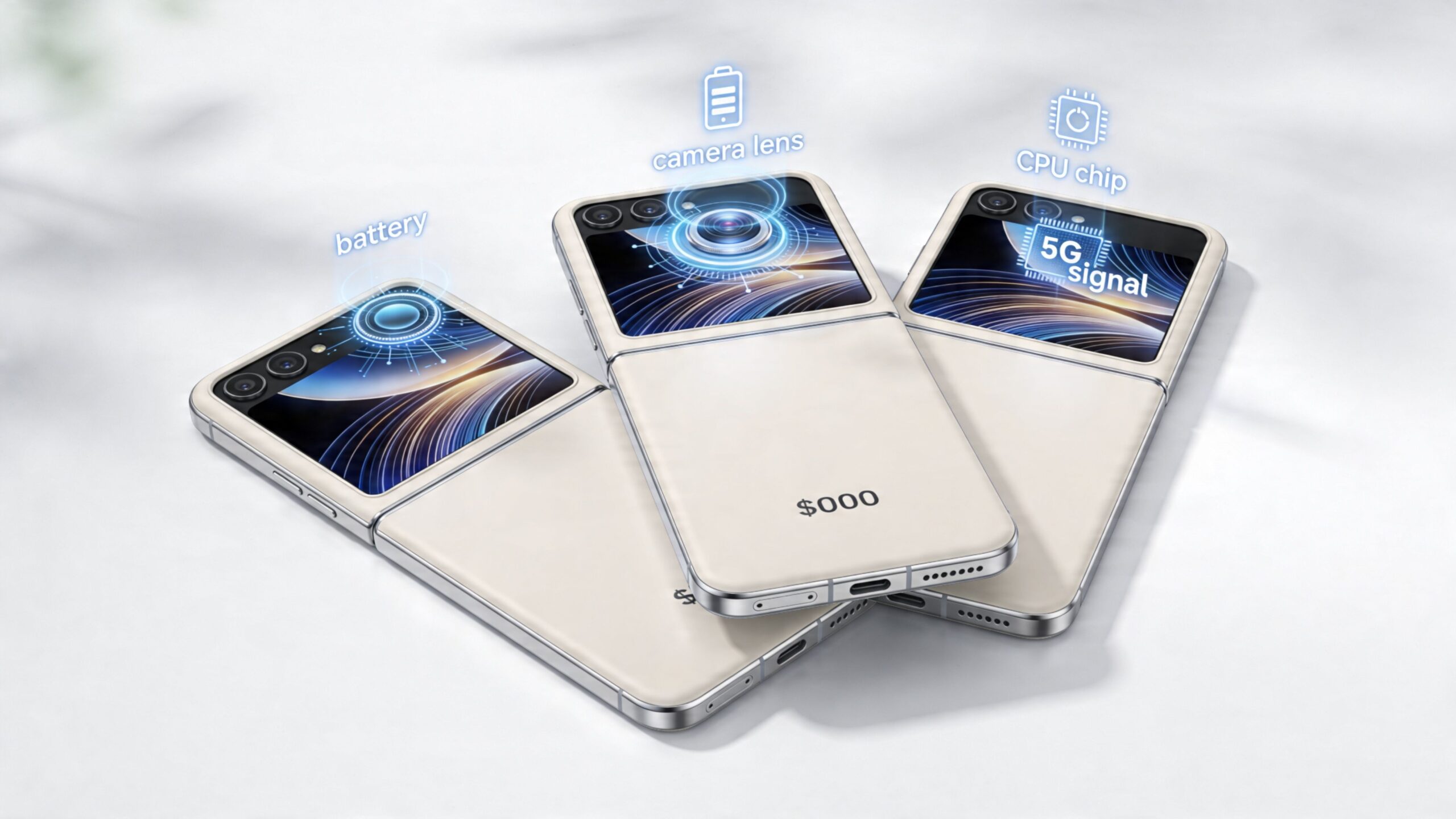
You’re probably here for a familiar reason. Your current phone still works, but it’s slower than it used to be, the battery drains by dinner, and every new flagship launch feels disconnected from reality. Spending four figures on a phone just doesn’t make sense when what you need is a dependable device for work, photos, maps, messages, banking, and a few years of clean daily use.
That’s why the best smartphones under 500 have become such a serious category. After testing a long list of mid-range devices over the years, we’ve reached the point where the right sub-$500 phone no longer feels like a compromise first and a savings move second. In 2026, this part of the market is better, more competitive, and easier to recommend than ever.
Table of Contents
- The New Golden Age of Mid-Range Smartphones
- Our Top Picks for the Best Smartphones Under 500
- What Specs Actually Matter Under 500 Dollars
- In-Depth Reviews of Our Recommended Phones
- The Real Trade-Offs What You Give Up at This Price
- Where to Buy and How to Find the Best Deals in 2026
- Frequently Asked Questions About Buying a Mid-Range Phone
The New Golden Age of Mid-Range Smartphones
You feel this category change in ordinary use, not in a spec sheet. The phone gets through a long workday without battery anxiety, the screen stays readable outside, the camera opens fast enough to catch the shot, and three years from now the software still needs to feel current.
That is why buying under $500 is no longer just about saving money. It is about avoiding the parts of a flagship price that many buyers never benefit from.
Across the phones we test, the gap has narrowed in the places people notice first. Good mid-range phones are now fast enough to stay responsive under real multitasking, OLED panels are bright and smooth instead of merely acceptable, and battery life is often stronger than on pricier devices because these phones pair large cells with less power-hungry chips. The old compromise was easy to spot after a week. Today, the smarter question is which trade-offs will still bother you after a year.
Why 2026 feels different
Manufacturers have become much better at spending the budget in the right places. Under $500, the best devices now put money into the display, battery, main camera, and thermal behavior instead of padding the spec list with weak extra lenses or flashy features that do little in daily use.
Software support also matters more than it did a few years ago.
A fast phone that stops getting platform updates early can feel like a short-term bargain. A slightly less exciting phone with better update policy, steadier battery health, and a cleaner interface often ages better. That is a significant shift in this part of the market. Longevity has become a feature, not an afterthought.
Smart buying beats prestige buying
For students, commuters, parents, and small business owners, the best phone is usually the one that stays dependable in year two and year three. We see that repeatedly in our testing. Buyers rarely complain that their mid-range phone lacked titanium rails or a dedicated zoom camera. They complain about battery drop-off, inconsistent camera performance, weak modem behavior, and short software support.
That is why this guide puts more weight on long-term value than headline specs. If you follow our broader phone reviews and buying advice at Tech Verdict, the pattern is consistent. The strongest phones in this category are not the ones that win on paper. They are the ones that still feel like a good decision long after the unboxing.
Our Top Picks for the Best Smartphones Under 500
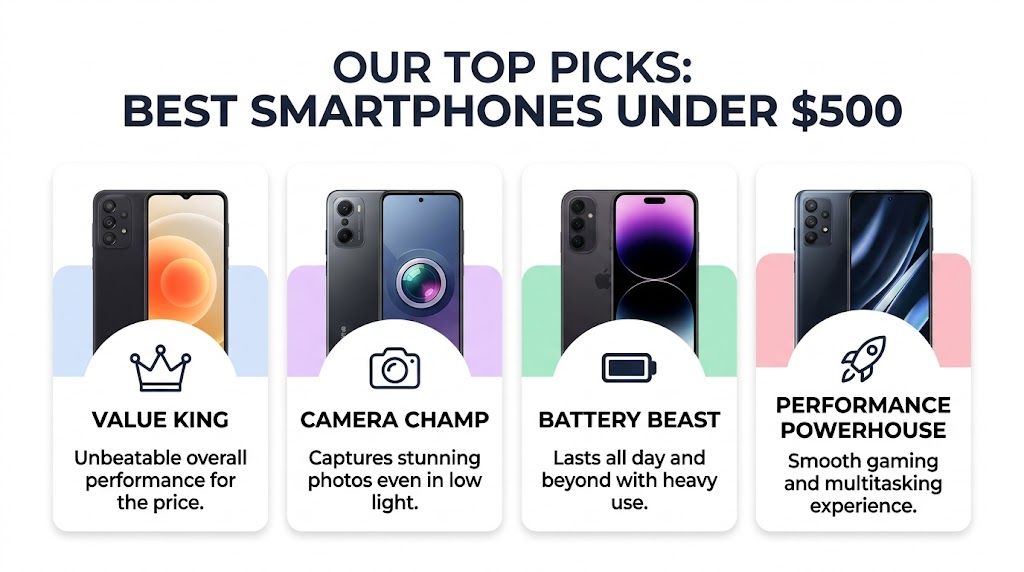
If you want the short version, these are the phones we’d point toward first.
Best Overall: Xiaomi Poco F8 Pro
The easiest recommendation for buyers who want speed, endurance, and a screen that feels expensive.Best Camera: Google Pixel 8a
The safest pick for point-and-shoot photography and a cleaner software experience.Best Battery Life: Xiaomi Poco F7
A strong value choice if your top priority is stretching a charge without babying the phone.Best Value: Nothing Phone 3a
For buyers who care about design, a distinct interface, and a balanced everyday experience.Best for Performance: Xiaomi 15T
Best suited to users who care more about responsiveness and gaming feel than camera prestige.
Quick comparison table
| Phone | Best for | Display | Battery focus | Camera approach | Main trade-off |
|---|---|---|---|---|---|
| Xiaomi Poco F8 Pro | Overall value | High refresh AMOLED | Class-leading endurance feel | Strong main camera, less camera-focused tuning | Software feel won’t suit everyone |
| Google Pixel 8a | Camera and software | Quality display with good tuning | Reliable rather than class-leading | Best image processing in this group | Charging and raw speed aren’t the headline |
| Xiaomi Poco F7 | Battery value | Smooth AMOLED experience | Excellent battery-first setup | Capable main camera | Less polished than top camera phones |
| Nothing Phone 3a | Design and balanced use | Attractive, fluid panel | Good day-to-day stamina | Consistent main camera results | Not the fastest option here |
| Xiaomi 15T | Performance priority | Fast, vivid panel | Solid all-round | Good enough for most users | Camera software isn’t the main reason to buy |
How we’d narrow it down fast
If you’re deciding between these phones, start with the one thing you’ll notice every single day.
Choose the Poco F8 Pro if you want the broadest blend of performance and battery life. Choose the Pixel 8a if you care more about reliable photos than benchmark bragging rights. Choose the Nothing Phone 3a if you want a phone that feels a bit different from the usual mid-range crowd.
If you’re shopping around upcoming launches before buying, it’s also worth checking the latest phones coming in March 2026 worth watching so you don’t buy right before a direct replacement lands.
Buy for your most repeated task, not the spec you’ll show off once.
What Specs Actually Matter Under 500 Dollars
You feel these trade-offs after a week, not on the product page. A phone can look unbeatable for $499 and still annoy you every day if the screen is dim outdoors, the camera misses moving subjects, or the brand stops caring after one major update.
That is why we put less weight on headline specs and more on what holds up over two or three years. Under $500, the best phones now cover the basics well. The primary separation comes from display tuning, camera consistency, battery behavior, thermal control, and how long the software will stay current.
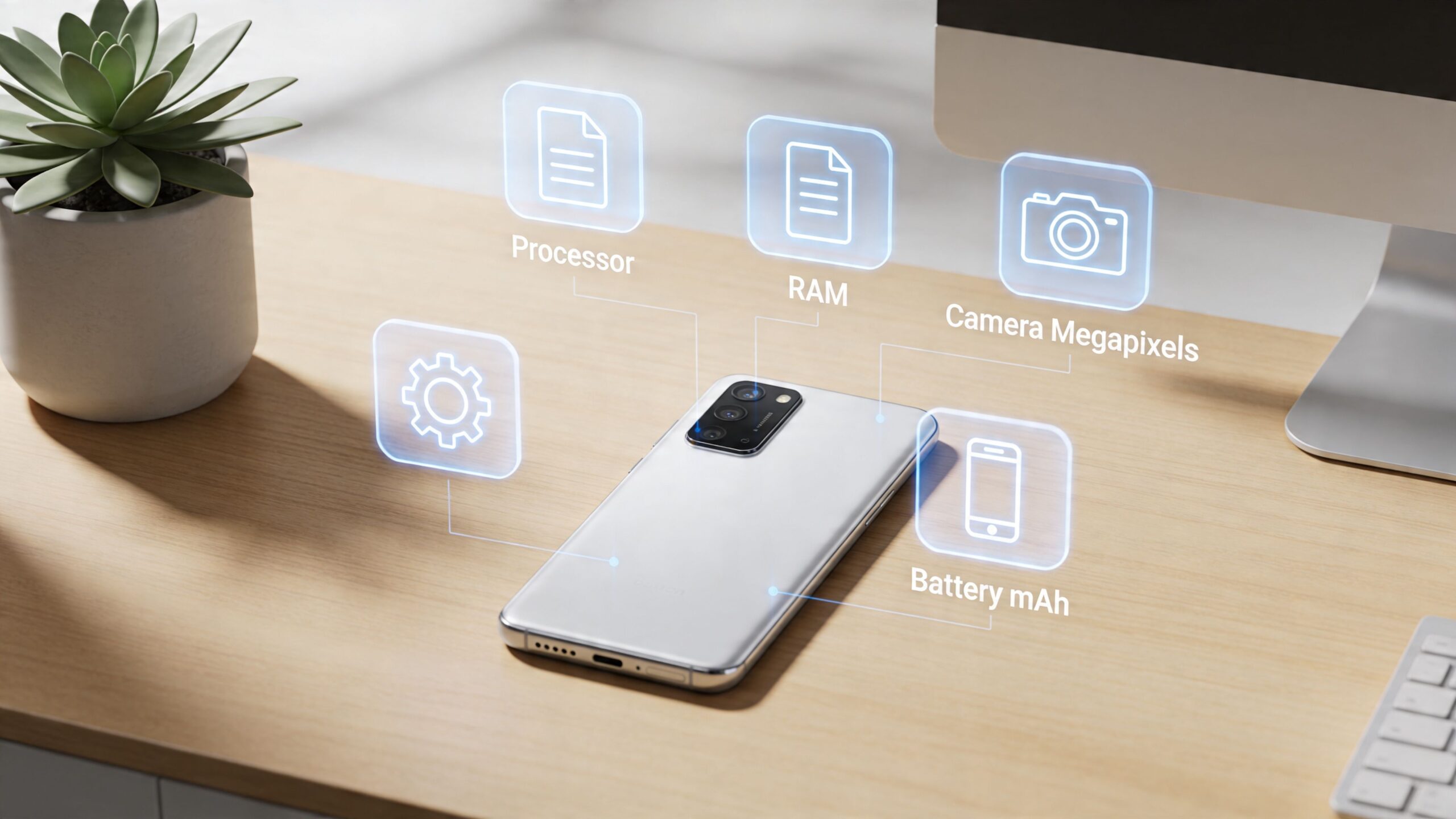
Mid-range phones have improved fast. High refresh OLED panels, large batteries, quick charging, and competent main cameras are no longer rare at this price. That sounds like a solved category. It is not. The differences that matter have shifted from whether a phone has a feature to how well that feature is implemented.
Performance that feels fast
Benchmarks help with rough sorting. Daily use tells the fuller story.
We look for quick app launches, stable frame pacing, fast camera startup, and how the phone behaves with several tasks open at once. A device can post decent numbers and still feel cheap if the software stutters, reloads apps too aggressively, or gets hot during navigation, gaming, and video calls.
The main question is simple. What kind of stress will your phone see?
- If you game often: buy for sustained performance and cooling, not a decorative camera setup.
- If you work from your phone: prioritize memory management, call stability, and software that stays out of your way.
- If you mostly message, browse, and stream: a well-optimized upper mid-range chip is enough, and long-term software support matters more than chasing peak scores.
We have tested plenty of phones that felt fast for ten minutes and average after a week. Thermal management and software tuning decide whether performance lasts.
Display quality you notice every day
The screen is the part you use most, so it deserves more attention than the spec sheet usually gives it. In this bracket, a good display does more for day-to-day satisfaction than a small bump in processor speed.
Three things matter most:
- OLED over LCD, because contrast is better and dark mode looks cleaner.
- A high refresh rate, because scrolling, gestures, and app transitions feel smoother.
- Strong brightness and good tuning, because outdoor use exposes weak panels fast.
Resolution matters less than brands want you to think. A well-calibrated 1080p OLED with enough brightness is a better buy than a sharper panel with poor visibility or strange color tuning.
Buy the screen you want to look at 200 times a day, not the camera count printed on the box.
If you want a better sense of where panels and connectivity are heading, our guide to the new phone tech worth waiting for adds useful context.
Battery, charging, and the daily rhythm
Battery capacity is only the starting point. Two phones with similar battery sizes can deliver very different results once you factor in modem efficiency, screen brightness behavior, background app control, and chipset power draw.
We care about endurance in mixed use, not just idle time. A phone should still feel dependable late in the evening after maps, photos, messaging, music, and some video. It should also charge fast enough that a short top-up gives you real breathing room.
Here is the practical filter we use:
| What matters | Why it matters |
|---|---|
| Battery efficiency | Decides whether the phone stays reliable through a long day |
| Charging speed | Makes heavy-use days easier to recover from |
| Heat during charging | Affects comfort and long-term confidence |
| Standby drain | Exposes weak software optimization |
Fast charging is useful. Controlled heat is just as important. A phone that charges quickly but runs hot every time raises more concern than one that is slightly slower and better behaved.
Cameras and the trap of extra lenses
Mid-range camera systems still rely on a familiar trick. One good main camera, plus extra lenses that add little outside the spec sheet.
The main camera carries the experience. If that sensor and image processing are strong, the phone will produce good results in the situations people care about most: family shots indoors, pets in motion, backlit scenes, night photos, and quick video clips. A weak main camera cannot be rescued by an extra macro lens.
When we test phones under $500, we focus on these points:
- Shutter response: delay ruins photos of kids, pets, and any moving subject.
- HDR balance: bright skies and dark shadows should both keep detail.
- Night processing: scenes should look clean without turning unrealistically bright.
- Video stability: short handheld clips should stay usable without heavy wobble.
Megapixels are easy marketing. Consistency is harder, and it matters more.
Software support is the longevity feature
This is the spec too many buyers ignore until the phone is already aging badly. Update policy affects security, app compatibility, bug fixes, and the odds that the phone still feels trustworthy in two or three years.
A slightly faster phone with weak support can be the worse deal. A balanced phone from a brand with a clear update record often gives better value over time, even if it loses a benchmark comparison on day one.
We want to see:
- Regular security patches
- A clear Android version promise
- Bug-fix follow-through after launch
- Software that is clean enough to stay responsive
Longevity is part of value. Under $500, that matters more than a flashy launch spec that you will stop noticing after the first month.
5G and connectivity
Connectivity should match how you use the phone, not the marketing checklist. For many buyers, stable calls, reliable Wi-Fi, solid Bluetooth, and broad 5G support are enough.
The bigger issue is future flexibility. Carrier switching, travel, hotspot use, and weak-signal performance expose modem quality much faster than a retail listing does. The primary difference is usually connection stability over time, not the length of the wireless feature list.
In-Depth Reviews of Our Recommended Phones
A mid-range phone usually proves itself at 7 p.m., not on a spec sheet. That is the moment when battery level, camera speed, haptics, software clutter, and screen quality all collide in normal use. We test these phones with that in mind, because under $500 the best choice is rarely the one with the longest feature list. It is the one you will still be happy using two or three years from now.
Xiaomi Poco F8 Pro
The Poco F8 Pro is the easiest all-around recommendation in this group. It feels fast immediately, but the bigger advantage is that it keeps feeling fast after the novelty wears off. App launches are quick, scrolling stays smooth, and the display gives the whole phone a more expensive character than the price suggests.
Design and daily use
Xiaomi went for a bold look, and that will divide buyers. The camera housing is large, the styling is more aggressive than understated, and the software still has a visual style that some people will enjoy less than Google or Nothing. In practice, the hardware lands better than the software. The screen is sharp, bright enough for outdoor use, and responsive enough that the phone rarely feels like a compromise.
The main trade-off shows up in consistency, not speed. The camera can produce very good shots, but it does not give the same reliable point-and-shoot confidence as a Pixel. Secondary cameras also feel more like extras than reasons to buy the phone.
Pros and cons
| Pros | Cons |
|---|---|
| Fast, fluid performance that still feels premium | Software design is busy compared with cleaner rivals |
| Excellent display for the money | Camera results are less consistent than Pixel |
| Strong everyday value across gaming, media, and general use | Large camera module and flashy styling will not suit everyone |
| Good fit for buyers who want fewer obvious compromises | Long-term software confidence is weaker than Samsung or Google |
Verdict
Buy this if you want the broadest mix of speed, battery confidence, and screen quality under $500. It is the practical pick for buyers who want one phone that does nearly everything well, even if it is not the most refined camera phone in the group.
Google Pixel 8a
The Pixel 8a wins on trust. You pick it up, take a photo, reply to messages, install your apps, and the phone gets out of the way. That matters more over time than a flashy benchmark lead.
It is also one of the safer buys if longevity is the priority. Google’s software support and cleaner Android experience give this phone a longer runway than many rivals, especially for buyers who keep phones for several years instead of upgrading often.
Camera and software experience
The Pixel 8a remains the easiest recommendation for people who photograph family, pets, food, and everyday moments. Its strength is not dramatic color or oversharpened detail. Its strength is a high success rate. Skin tones usually look more believable, HDR is better controlled, and motion handling is often more forgiving when the subject will not stay still.
The software experience is calmer too. There is less visual noise, fewer duplicate apps, and less setup friction out of the box. That makes a difference after six months. It also helps the phone age well, which is one reason buyers comparing long-term value often look at Google and Samsung first. If you are also weighing Samsung’s pricing direction this year, our guide to the Galaxy S26 price expectations gives useful context on where the broader market is heading.
Pros and cons
| Pros | Cons |
|---|---|
| Excellent camera reliability in everyday use | Charging is less aggressive than many Chinese rivals |
| Clean Android experience with fewer distractions | Raw performance is not the focus |
| Strong long-term ownership appeal | Value depends heavily on whether you care about the camera |
| Better software support outlook than many sub-$500 competitors | Hardware looks less exciting on paper |
A quick hands-on video helps show how this class compares in practice:
Xiaomi Poco F7
The Poco F7 makes sense for buyers who prioritize stamina and day-to-day speed over polish. It is the phone for heavy users who stream a lot, run maps for long stretches, or do not want to think much about battery level.
Where it makes sense
In daily use, the F7 feels close enough to the F8 Pro that some buyers should save the money. Navigation is smooth, multitasking is strong, and the display still gives you that high-value mid-range feel. The difference is refinement. Camera tuning is less dependable, and the software experience feels more utilitarian than carefully shaped.
That trade-off is not trivial. A phone can have strong core hardware and still feel less satisfying if notifications, app management, and camera processing are inconsistent. The F7 is best for buyers who know exactly what they want and are comfortable giving up some finesse to get it.
Pros and cons
| Pros | Cons |
|---|---|
| Strong endurance for demanding daily use | Camera quality is good enough, not a standout |
| Fast performance for the price | Software polish trails Google, Samsung, and Nothing |
| Good display and media experience | Less balanced overall than the top pick |
| Smart choice for battery-first buyers | Long-term ownership appeal depends on your tolerance for Xiaomi’s software |
Nothing Phone 3a
The Nothing Phone 3a is the alternative for buyers bored by generic mid-range phones. Its appeal is not raw power. It is the way the whole product feels considered.
Design and real-world value
Nothing’s hardware and interface design give this phone a distinct identity without making it harder to live with. That is harder to pull off than it sounds. Plenty of phones try to stand out and end up feeling gimmicky. The 3a mostly avoids that problem. The software looks intentional, the interface stays cleaner than many rivals, and the phone feels cohesive in a way that spec-heavy competitors often do not.
The trade-off is straightforward. You are choosing character and usability over maximum performance per dollar. For some buyers, that is absolutely the right call. A phone you enjoy using every day often ages better than one that wins on paper and annoys you in smaller ways.
Pros and cons
| Pros | Cons |
|---|---|
| Distinctive design without feeling cheap | Not the fastest phone here |
| Cleaner, more thoughtful software feel | Camera is competitive, not class-leading |
| Strong day-to-day usability | Raw-value shoppers may still prefer Poco |
| Good pick for buyers who want something different | Software support should be checked against the exact market and model at purchase |
The Real Trade-Offs What You Give Up at This Price
A good sub-$500 phone usually feels excellent for the first week. The differences show up six months later, after the novelty wears off and daily annoyances start to matter more than the spec sheet.
That is why we judge this price tier on long-term use, not just launch-day value. Mid-range phones have improved fast, but the cuts have shifted rather than disappeared.
What you’ll actually notice
Performance is usually fine. Consistency is where cheaper phones still separate themselves from better ones. A mid-range chip can handle messaging, maps, video, and light gaming without complaint, but you may see longer camera processing, more app reloads, or a rougher feel after major software updates. We pay close attention to that in testing because short bursts of speed matter less than how stable a phone feels a year into ownership.
Build quality has a similar story. Plastic backs and frames are common, and that is not automatically a downgrade. Plastic often handles drops better and keeps weight down. What you give up is the tighter fit-and-finish, stronger vibration motor, and more polished in-hand feel that better phones usually deliver.
Cameras are still the easiest place for brands to oversell. In this bracket, the main camera does most of the work. Ultra-wide quality often drops hard in low light, and extra macro or depth sensors rarely change the experience in a meaningful way. Buyers who keep a phone for several years should care more about shutter speed, skin tones, and night consistency than the number of lenses on the back.
Features that usually stay above this tier
A few upgrades still tend to cost more:
- Wireless charging: nice to have, rarely decisive.
- Stronger water resistance: some models offer it, but coverage is less consistent than in pricier phones.
- Good telephoto zoom: digital crop is still the norm under $500.
- Better speakers and haptics: acceptable is common. Excellent is not.
- Longer software support: one of the biggest differences for future-proofing.
Software support deserves more weight than many buyers give it. A phone that saves you money upfront can become the worse deal if updates arrive slowly, security support ends early, or the interface gets heavier over time. We would take one less rear camera and an extra year of reliable updates almost every time.
That also affects resale value and day-two confidence. Brands offering aggressive hardware at low prices sometimes cut corners in support, repair access, or update clarity. If you are tempted to stretch into flagship pricing for fewer compromises, our look at whether the Galaxy S26 price shifts the value comparison helps frame that decision.
Where to Buy and How to Find the Best Deals in 2026
Where you buy matters almost as much as what you buy. A great phone with the wrong carrier restrictions, weak return terms, or uncertain warranty support can become a headache fast.
For most buyers, a phone without carrier restrictions is the smarter route. It gives you more carrier flexibility, cleaner resale value, and fewer surprises with preloaded apps or financing terms. Carrier deals can still make sense, but only if you’ve read the conditions carefully and you know you’re staying put.
Best places to start
These are usually the safest places to shop for a mid-range phone:
- Manufacturer websites: often the best source for launch promotions, color options, and trade-in offers.
- Major electronics retailers: useful for returns, in-store pickup, and comparing phones in person.
- Large online stores: convenient for price tracking and wide availability.
- Photography and specialist tech retailers: often good for SIM-free stock and clearer listings.
Smart timing beats impulse buying
If you’re not in a rush, patience usually pays. A few practical habits help:
- Watch prices after launch. Mid-range phones often settle into better value after the first wave of attention.
- Check bundle language carefully. Accessories, gift cards, or trade-in bonuses can matter more than a small headline discount.
- Compare direct purchases against carrier math. The monthly payment can look better while costing more overall.
- Buy around major retail events if your current phone can hold on a little longer.
It’s also worth tracking broader retail shifts, especially where AI-assisted storefronts are changing product visibility and recommendations, as covered in this report on Walmart and Google’s AI shopping alliance with Gemini integration.
Frequently Asked Questions About Buying a Mid-Range Phone
Should I buy a used flagship instead of a new mid-range phone
Sometimes. I recommend a used flagship only when you can verify battery health, check the update policy, and buy from a seller that offers a proper return window.
An older premium phone can still beat a new mid-ranger for telephoto zoom, build quality, haptics, and extras like wireless charging. A new mid-range phone gives you a fresh battery, lower risk, and a simpler ownership history. In our testing, that trade-off usually matters more after six months than it does on day one, especially for buyers who plan to keep the phone for years.
For long-term value, the new phone is usually the safer bet.
How much software support is good in 2026
Support length matters, but follow-through matters just as much. Some brands promise years of updates and then deliver them slowly or unevenly.
We treat software support as part of the phone, not a footnote. A device that gets regular security patches and major Android updates will stay safer, hold its value better, and feel current for longer. If you keep phones for three to five years, this should sit near the top of your checklist, right alongside battery life and camera quality.
Are brands like Xiaomi and Nothing reliable
Yes, with caveats.
Reliability includes more than whether the phone survives a drop or keeps decent battery health. It also means bug levels, update speed, repair options, and how easy it is to get support in your region. Xiaomi often wins on raw hardware for the money. Nothing usually offers a cleaner software experience and a more focused product strategy. Neither is automatically the better choice. The better choice is the one with solid local support and fewer compromises you will notice every day.
Is a camera phone under 500 good enough for work and content
For many people, yes. The main camera matters far more than having three or four rear lenses.
A good phone under $500 can handle product photos, social clips, video calls, scanning documents, and casual content work without much trouble. Where these phones still fall short is consistency. Low-light results can vary, video stabilization is often weaker than on pricier models, and zoom quality usually drops fast once you move past the main sensor. If content creation pays your bills, those gaps are easier to notice.
What matters most if I want a phone that lasts
Prioritize these features:
- Long software support
- Stable battery life and charging behavior
- A good OLED display
- A reliable main camera
- Consistent day-to-day performance
That mix leads to better ownership over time than chasing fast charging numbers, extra lenses, or flashy design tricks.
Mid-range phones have improved to the point where many buyers are better served here than in the premium tier. The best ones do not just look good on a spec sheet. They stay pleasant to use after the honeymoon period, and they give you fewer reasons to upgrade early.
If you want more buying guides, verdict-style reviews, and practical tech advice before you spend your money, explore Tech Verdict. Which phone under $500 are you leaning toward right now, and what matters most to you: camera, battery, or long-term software support?