
Sunlight is brutal on TVs. A screen that looks rich and cinematic at night can turn gray, flat, and mirror-like by mid-afternoon. Dark scenes disappear first. Sports lose depth. News graphics stay visible, but faces look dull and washed out.
That usually doesn’t mean you bought a bad TV. It means you bought a TV for the wrong room.
The best tv for bright room use isn’t just the one with a premium badge or the prettiest showroom demo. It’s the model that can stay visible when windows are uncovered, lamps are on, and your room throws light at the panel from every angle. That takes more than good picture quality in a dark lab. It takes serious brightness, smart reflection control, and in some homes, a setup that works with the lighting around it.
This guide focuses on what works in sunlit living rooms, open-plan spaces, and day-first viewing setups.
Table of Contents
- Why Your TV Looks Washed Out on a Sunny Day
- The Two Pillars of Bright Room Performance
- The Great Debate OLED vs QLED in the Sun
- How Tech Verdict Tests for Bright Room Viewing
- The Best TVs for Bright Rooms in 2026
- Optimize Your Room to Defeat Glare
- What's Next for Bright Room Viewing
Why Your TV Looks Washed Out on a Sunny Day
The failure usually happens in one specific moment. You start a movie in the afternoon. A moody scene comes up. Instead of shadow detail, you get a hazy reflection of the window behind your sofa and a faint version of the scene underneath it.
That’s the bright-room problem in real life. The TV isn’t only trying to show an image. It’s competing with the room.
A sunny living room attacks picture quality in two ways at once. Ambient light lowers perceived contrast, so blacks stop looking black. Direct reflections bounce off the panel, so bright objects in the room sit on top of the content like a second image.
In a dark room, almost any decent TV can look good. In a bright room, weak screens get exposed fast.
That’s why buyers get confused after reading general TV reviews. A set praised for contrast and cinematic depth can still disappoint in a sunlit space. If your room has large windows, pale walls, overhead lights, or glass furniture, you need a TV chosen for those conditions.
The good news is that this is a solvable problem. You don’t need to guess, and you don’t need to fall for marketing labels like “anti-glare” without understanding what they do. The right set can stay punchy in daylight and still look balanced at night.
If you follow broader consumer tech coverage, the same real-world testing mindset shows up across technology reporting and device analysis. Specs matter, but room conditions matter just as much.
The Two Pillars of Bright Room Performance
Some specs matter a little in a bright room. Two matter a lot. If you’re shopping for the best tv for bright room viewing, peak brightness and reflection handling decide most of the outcome.
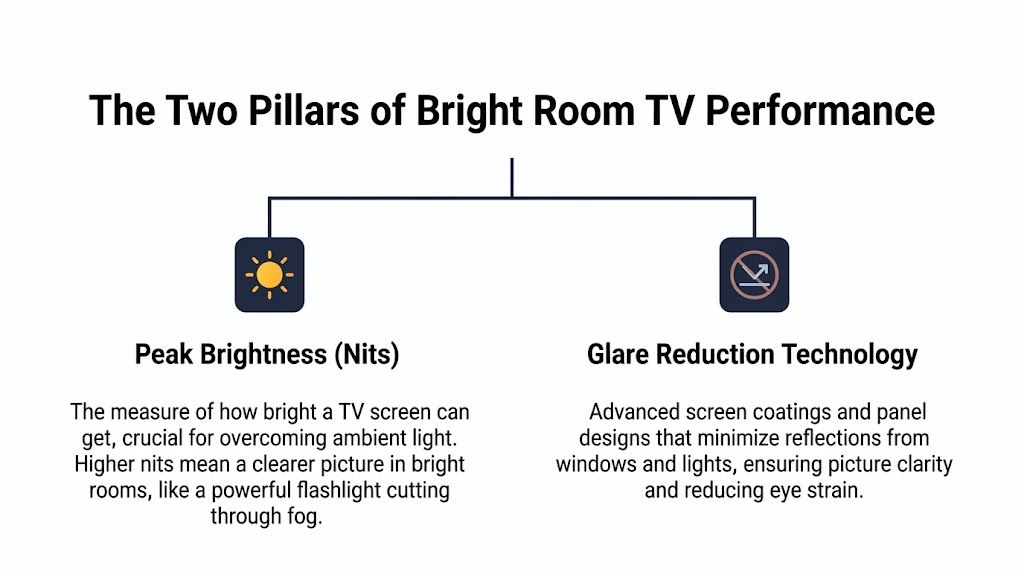
Peak brightness decides whether the image survives daylight
Brightness is measured in nits. The simple version is this: more nits gives the TV more power to push the image through ambient light.
Industry benchmarks put the floor at at least 500 nits, while 1000 nits or higher is ideal for bright rooms, especially in homes where ambient light can average 300 to 1000 lux according to Mount-It’s bright-room TV benchmark guide. That’s the point where a TV starts to feel made for daylight rather than merely usable in it.
In practice, brightness helps in three ways:
- Dark scenes stay readable: Shadow areas don’t collapse into gray mush as quickly.
- HDR highlights keep their impact: Sun glints, stadium lights, and specular detail still pop.
- Color holds together better: A brighter image looks more saturated to your eye in a lit room.
Consider trying to read a phone outdoors. If screen brightness is too low, the content hasn’t disappeared. The environment has overpowered it.
Reflection handling decides whether your TV becomes a mirror
Brightness alone won’t save a screen that reflects everything. I’ve tested TVs that can get very bright but still become annoying because every lamp, window frame, and ceiling fixture sits on the panel.
Reflection handling comes from panel finish and screen treatment. Some sets use glossy finishes that preserve contrast well but can behave like mirrors in the wrong placement. Others use matte or semi-matte layers that scatter reflections, making the screen easier to watch in daytime.
That sounds simple, but the trade-off is real. A screen that cuts reflections aggressively may also change how blacks and fine detail look compared with a glossy panel in a dark room.
Practical rule: If your room gets direct sunlight on the screen, reflection control matters as much as raw brightness. If the room is bright but indirect, brightness usually matters more.
A lot of buyers focus only on panel type and miss this. That’s a mistake. The best bright-room TVs combine strong light output with screen treatments that stop obvious mirror effects.
If your living room also uses connected bulbs, motion scenes, and adaptive lighting, it’s worth following broader smart home device coverage because the room itself now changes hour by hour.
The Great Debate OLED vs QLED in the Sun
OLED versus QLED used to be an easy bright-room argument. OLED was for dark-room movie fans. QLED and Mini-LED were for anyone with windows. That divide isn’t as clean now, but the core trade-off still matters.
Why Mini-LED and QLED still dominate harsh daylight
If your room gets strong daylight for long stretches, Mini-LED and QLED are still the safer buy. They’re built to hit much higher brightness, and that brute force matters when sunlight lands near or around the screen.
Samsung’s QN90D Neo QLED is a good example. Hands-on testing described it as maintaining visibility during 3 weeks of peak afternoon sun exposure with curtains open, with measured brightness of up to 3000 nits and over 2000 local dimming zones, according to the cited hands-on bright-room review video. In practical terms, that’s the kind of TV you buy when your room wins most lighting fights.
Hisense’s upper-tier Mini-LED models also fit this category. They don’t rely on one trick. They combine high brightness, local dimming, and quantum dots so the picture doesn’t lose all of its color punch when the room gets loud.
Why modern OLED is better than many buyers assume
OLED isn’t out of the game anymore. Recent QD-OLED sets have improved enough that bright-room performance is now a serious selling point on some premium models.
RTINGS’ 2026 rankings highlighted the Samsung S95F OLED as the top bright-room TV because its QD-OLED panel delivers excellent peak brightness and handles both indirect and direct reflections effectively. That matters because older OLED advice still lingers online, and a lot of it is now outdated.
The catch is placement. Even strong OLEDs still make the most sense in rooms with controlled glare rather than relentless direct sun. If your seating faces a wall of windows, a top Mini-LED remains easier to recommend.
The anti-glare durability trade-off most buyers miss
This is the part most buying guides skip. Matte and anti-glare layers can work brilliantly at first, but they aren’t free of maintenance trade-offs.
User forums and lab tests indicate that matte anti-glare coatings can accumulate micro-scratches up to 30% faster in sunlit rooms and may lose about 15% of their effectiveness after 18 to 24 months, while brighter glossy Mini-LEDs show less performance degradation over the same period, as noted in TechRadar’s bright-room TV discussion.
That doesn’t mean matte OLEDs are a bad idea. It means you should buy them with your eyes open.
A few practical consequences follow:
- Cleaning matters more: Dust and careless wiping do more damage on coated surfaces.
- Sun-heavy rooms age coatings faster: The screen may not look the same after prolonged daytime exposure.
- Longevity favors some bright glossy panels: A very bright Mini-LED can offset reflections without relying as heavily on a delicate matte finish.
If you want the most resilient setup for a family room that gets hammered by sunlight every day, I’d still lean Mini-LED. If you want the most refined picture and your room is bright but manageable, modern OLED has earned its place back in the conversation.
How Tech Verdict Tests for Bright Room Viewing
A bright-room verdict is only useful if the TV is tested in conditions that resemble an actual living room. Looking at a panel in a dim demo space tells you almost nothing about how it behaves at 2 p.m. with curtains open.
We test in light, not just in darkness
The first thing we look for is whether the screen keeps image integrity when the room stops cooperating. That means checking how visible dark scenes remain, whether bright highlights still look intentional rather than harsh, and whether reflections stay in the background instead of becoming the main event.
We also pay attention to the type of reflection. Some TVs handle soft room light well but struggle with direct window glare. Others suppress direct hotspots better than expected but give the whole image a slightly flatter look.
A bright-room test isn’t just “how bright does it get?” It’s “how watchable is it when the room fights back?”
Color matters too. A TV can look impressive in a store because it’s blasting blue-white light, then look thin and unnatural at home. For bright-room use, the better screens keep enough color intensity and contrast structure that daylight doesn’t strip the picture of character.
What matters more than a showroom demo
Specs are part of the story, but behavior holds greater significance. A showroom loop hides weak reflection handling, and retail lighting rarely matches a living room with side windows and mixed lamp light.
That’s why we judge bright-room TVs on lived-in use cases:
- Sports in daytime: Fast motion, score bugs, and field detail expose washout quickly.
- Movies with dark scenes: Weak sets lose shadow detail fast in sunlit spaces.
- News and general TV: Easy content can still reveal screen reflections and uneven brightness.
- Streaming apps in mixed light: Menus, subtitles, and compressed content show whether the panel stays comfortable over long viewing sessions.
If you spend most of your viewing hours with Netflix, live sports, or daytime channels, your needs overlap closely with broader streaming-focused device coverage because interface clarity and mixed-content performance matter almost as much as headline picture specs.
The Best TVs for Bright Rooms in 2026
The strongest bright-room TVs don’t all solve the problem the same way. Some overpower glare with extreme brightness. Some cut reflections so effectively that the room stops dominating the image. Others give you most of the benefit without pushing into flagship pricing.
Here’s the short list I’d start with.
2026 bright room TV recommendations at a glance
| Model | Technology | Peak Brightness (Nits) | Reflection Handling | Best For |
|---|---|---|---|---|
| Hisense U8N | Mini-LED | 3,000 | Excellent | Best overall |
| Samsung QN90D Neo QLED | Neo QLED | Up to 3000 | Excellent | Extreme glare |
| Samsung S95F | QD-OLED | Qualitatively very strong | Excellent | Best OLED |
| Hisense U6 series | Budget TV | Often exceeding 1000 | Good for the class | Budget bright-room upgrade |
| Insignia 75-inch QF series QLED Fire TV | QLED | Qualitatively strong for value | Solid | Big-screen value |
| Sony Bravia 5 65-inch | Mini-LED | Not specified here | Strong | Processing and color balance |
For more device verdicts across categories, the broader review section is useful when you’re comparing TVs with other living-room upgrades.
Best overall Hisense U8N
If you want one answer for most buyers, the Hisense U8N is the easiest recommendation.
Its measured peak brightness reaches 3,000 nits with 1,536 local dimming zones, and it covers 97% of the DCI-P3 color gamut, according to the lab-backed figures in gagadget’s bright-room TV roundup. Those numbers matter because the U8N doesn’t just get bright. It keeps color saturation and highlight control when many TVs start to look stressed.
In a real living room, this translates well. Sports look forceful. HDR highlights cut through daylight without turning whites into a mess. Local dimming gives the picture enough structure that the screen still looks premium when the room is bright.
Its clearest trade-off is connectivity. It only has two HDMI 2.1 ports. If you run a current-gen console, a gaming PC, and a high-end sound system, you’ll feel that limitation faster than on some rivals.
Buy this one if you want flagship-level daylight performance without overthinking the category.
Best for extreme glare Samsung QN90D Neo QLED
The Samsung QN90D is the TV I’d point to for rooms with significant light challenges. If your TV wall sits near large uncovered windows, this is the kind of set designed for that fight.
The cited hands-on testing says it stayed visible through 3 weeks of peak afternoon sun exposure with curtains open, and its up to 3000 nits of brightness plus over 2000 local dimming zones explain why. Strong reflection control is part of the story too, and TechRadar’s tester ranked it first for low reflectiveness and high brightness in reflection-heavy conditions in the same referenced source already noted earlier.
What stands out with the QN90D is consistency. Some bright TVs look spectacular in one mode or one type of content. Samsung’s better bright-room sets tend to stay usable across sports, TV, and HDR movies without constant tweaking.
The trade-off is that if you mostly watch at night and care more about absolute black-level finesse than daytime survival, there are TVs with a more refined dark-room look.
Best OLED Samsung S95F
If you want OLED picture quality but you’re not willing to give up on daytime viewing, the Samsung S95F is the standout pick from the verified data.
Its QD-OLED panel is highlighted as the top bright-room OLED in RTINGS’ 2026 ranking, with strong peak brightness and notably effective reflection handling for both indirect and direct light. That makes it different from the old stereotype of OLED as a dim, window-phobic technology.
This is the TV for buyers who want a premium image first and bright-room competence second, without making that second priority an afterthought.
The caution here is long-term care. Matte and anti-reflective surfaces can be fantastic in the first months and less impressive later if the room is very sunny and the screen gets cleaned often. If that maintenance trade-off bothers you, a brighter glossy Mini-LED remains the safer long-run choice.
Best budget pick Hisense U6 series
Not everyone needs a flagship. Some buyers just need a visible, competent TV that won’t collapse in a bright room the way older budget sets do.
That’s where the Hisense U6 series makes sense. The verified data notes that these budget models often exceed 1000 nits, making them viable bright-room upgrades in AVForums’ 2025 picks, as referenced in the earlier benchmark material.
That matters because older low-cost TVs often failed in two ways at once. They weren’t bright enough, and they had poor reflection control. The U6 line at least gives budget shoppers a realistic path to daytime usability.
You still give things up. You won’t get the same local dimming precision, premium processing, or flagship build quality as the U8N or QN90D. But for many living rooms, the jump from an older entry-level LED to a modern bright budget Hisense is obvious immediately.
Best big-screen value Insignia 75-inch QF series QLED Fire TV
Large screens are harder in bright rooms because a bigger reflective surface can amplify the problem. That’s why value picks at 75 inches often disappoint more than smaller TVs.
The Insignia 75-inch QF series QLED Fire TV stands out because it combines quantum dot color with a big panel and a 144Hz native refresh rate, while pushing strong brightness for the class and dealing better with reflections than many large low-cost alternatives in the verified benchmark data.
This isn’t the TV I’d buy over the very best Mini-LED sets if daylight performance is mission-critical. It is the TV I’d consider if you want a huge screen without moving straight into premium flagship territory.
A large sports-focused room is where this one makes the most sense.
To get a feel for how reviewers frame current bright-room TV buying, this overview is a useful companion:
Best if you want Sony processing Sony Bravia 5 65-inch
The Sony Bravia 5 65-inch is for the buyer who values image polish as much as panel strength. The verified data points to its Mini-LED backlighting and XR Luminosity Pro, plus coverage of nearly the entire DCI-P3 color space for lifelike color in bright settings.
Sony sets often appeal to viewers who don’t want to micromanage picture settings. They tend to present broadcast TV, movies, and streaming content in a balanced, finished way.
For bright rooms, that means a picture that usually looks natural rather than exaggerated. The trade-off is that some rivals may win on raw headline brightness or pure value.
Optimize Your Room to Defeat Glare
Even the best tv for bright room use can be sabotaged by a bad setup. I’ve seen excellent TVs look mediocre because the screen was mounted directly opposite a window or under a lamp that hit the panel at the perfect reflection angle.
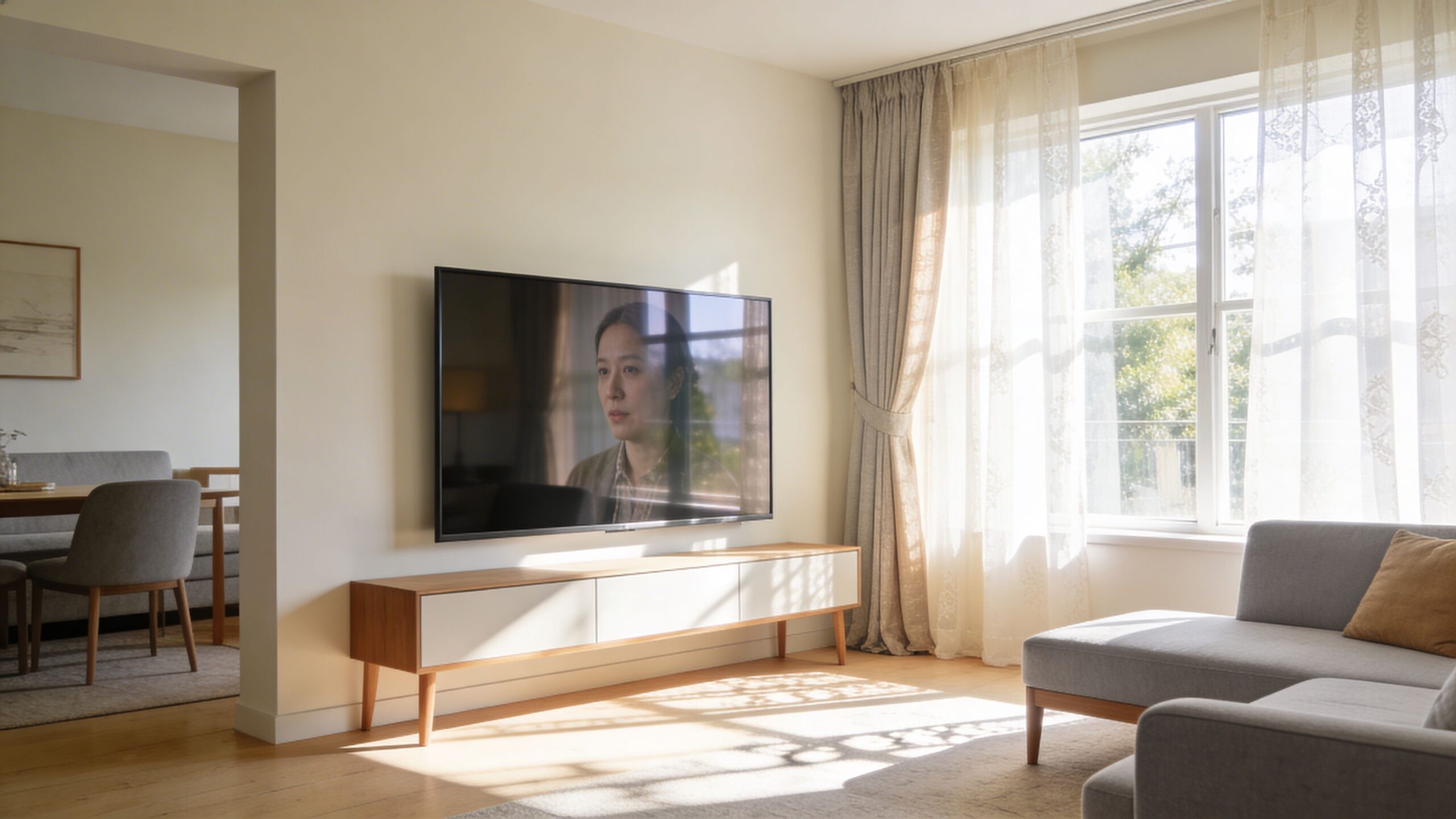
Place the TV for angle control, not just furniture symmetry
The first fix is usually positional. If a window faces the screen directly, the TV is fighting a battle it can’t fully win. Shift the panel so daylight hits from the side when possible.
A few layout rules help fast:
- Avoid direct opposition: Don’t place the TV straight across from the brightest window in the room.
- Check seated reflections: Sit in your usual spot at midday and look for mirror hotspots before final mounting.
- Use adjustable mounts: A slight tilt or angle can reduce the most annoying reflections.
Use lighting that works with the screen instead of against it
Smart lighting changes the equation. The impact is often ignored, but smart bulbs can fluctuate between 500 and 2,000 lux, and some TV light sensors lag when room brightness shifts. Recent firmware in select 2026 TVs integrates with Aqara APIs to reduce glare by up to 40% through coordinated lighting control, according to Good Housekeeping’s bright-room TV guide.
That means your bulbs, hub, and automation rules can either support the TV or undermine it.
If your home already uses connected lighting, practical ideas from guides like these cheap smart home finds for an IKEA trip can help you think beyond the screen itself.
Smart lights should lower visual conflict around the TV, not create a light show that keeps forcing the panel to adjust.
Small setup changes that usually help fast
These changes don’t require a new TV:
- Use blinds before blackout curtains if you still want daylight in the room. The goal is glare control, not cave mode.
- Move floor lamps away from the screen plane so they don’t create direct point reflections.
- Turn off aggressive eco modes if they dim the picture too much during daytime viewing.
- Reserve movie modes for night and use a brighter calibrated mode during the day.
- Clean coated screens carefully and as little as necessary, especially on matte OLED panels.
A lot of bright-room performance comes from reducing the room’s worst habits.
What’s Next for Bright Room Viewing
Bright-room TV design is moving in a useful direction. Premium OLED is better in daylight than it used to be. Mini-LED keeps pushing brightness harder. Anti-reflection design is becoming a bigger competitive battleground instead of a side feature.
The next leap could come from 2026 Micro-LED prototypes such as Samsung’s QN990F, which are described in the verified data as promising self-healing nano-coatings, though those pre-release specs still lack independent verification. That’s worth watching, especially for buyers who want both extreme brightness and less concern about long-term coating wear.
For now, the buying advice is straightforward. Prioritize the two specs that matter most. Match the panel type to your room, not to internet mythology. And don’t ignore setup, because lighting and placement can make a good TV look bad.
If you want more tested buying guides, comparisons, and practical consumer tech coverage, visit Tech Verdict. We test it. We judge it. You decide.
What’s the biggest problem in your room right now: direct window glare, overhead light reflections, or a TV that isn’t bright enough?